
Gougane Barra is located in a beautiful part of the South West of Ireland, ideal if you are looking for some of Irelands scenic countryside to visit.
The area of Gougane Barra can be visited at any time of the year but it is especially beautiful in the Summer months. An ideal area in West Cork for cycling or walking with many walking and nature trails in the Gougane Barra Forest Park, and there is also a little section which you can drive around, a nice feature.

On entering Gougane Barra you are met with the natural beauty of the hills which tower over Gougane Barra Lake and then the well known St Finbarr's Oratory or Small Church out in the Lake on the little island all on its own. Just behind the Oratory are the remains of St Finbarr's monastery from the 6th century, with beautiful old stations of the cross above the ancient prayer cells. It was here that St Finbarr spent time, before making his way to Cork. The Oratory has some lovely stained glass windows. Pilgrims still visit this holy site and the 25th of September is the feast of St Finbarr with a mass being held on the Sunday closest to this date. During the Penal times people made their way to Gougane Barra for Mass and hence the many Mass Rocks around the West Cork area.
The scenery in this area is breath taking and it offers the visitor a little time out in this peaceful valley. Cork's River Lee has its source in Gougane Barra's Lake, where it flows through Ballingeary and onwards towards Cork City.
It must be the most photographed Church in this part of Ireland and many a happy wedding have enjoyed this wonderful setting for their photographs. Truly magical, peaceful in a stunning location.

Take some time out and enjoy a coffee or some great food at the nearby Gougane Barra Hotel and just enjoy the tranquil views of the lake and mountains.
Gougane Barra Hotel - BOOK NOW
Gougane Barra is just a 1 hr 30 minutes drive from Cork driving via Ballingeary, a popular Irish college area, and on through Inchigeela. Gougane Barra is also the same distance from Kenmare, County Kerry. Just 50 minutes to Glengarriff.
Location: Guagan Barra Forest Park is located 5km west of Ballingeary on R584 to Bantry, at the Pass of Keimaneigh.

History: The name Guagan Barra derives from St. Finbar, who according to tradition, built his monastery on the island here in the 6th century. Guagan was at one time part of the territories of the O'Leary's who lost possession of the land in the plantation that followed the Cromwellian wars. Subsequently it passed to the Townsend family and ultimately the farming tenants under the Land Acts in the early part of this century.
The ruins on the island are not part of St. Finbar's original settlement but were erected around 1700 by Rev. Denis O'Mahony who, following the footsteps of St. Finbar, retired to a life of asceticism here. Because of its isolation, in the days of the Penal Laws people travelled from areas far beyond the bounds of the valley to hear Mass in Guagan Barra. One of the most famous 'Mass Path' was that which led from the Borlin Valley to the west via Gowlane Stream and down into Com Rua by way of the savage cleft of Poll.

Habitat: The Guagan Barra area, and indeed the whole of south Cork, south Kerry and the Dingle Peninsula, is composed of old red sandstone. The characteristic layering or bedding of the sedimentary rocks can be clearly seen in the high cliffs around Com Rua at the head of the Guagan Barra valley. Guagan Barra Lake lies in a rock basin carved out by the ice but nowhere does it reach depths greater than 12 meters.
Forest Walks: Guagan Barra is unusual among forest parks in that it provides drive around facilities for the motorist and a motor trail can be followed right along the ring road. There are also a number of signposted paths.
Tree Species: The Forest Park comprises some 142 hectares. The area was virtually treeless until 1938 when the afforestation programme began. Plantings were largely of lodgepole pine, Sitka spruce and Japanese larch - three species that thrive in poorer soils and stand up well to exposure. Sitka spruce, which is particularly resistant to constant winds and suits a wide variety of soils, accounts for 40% of the area.
Biodiversity: Flora - In the Park natural vegetation occasionally reaches down to the roadside on rock outcrops and on stream banks but it is to be seen to better advantage as one approaches the upper fringes of the forest. On drier slopes fringe grasses such as brents and fescues, with heather and ling are abundant. Moist slopes have a large collection of purple moor grass while wet hollows harbour bog mosses and cotton grasses. Sedges and rushes flourish well here as do fox's cabbage, butterworths and sundews. Rock faces are covered with lichens.
Fauna: The otter hunts and fishes in secluded spots by night and day as does the stoat. The nocturnal badger, the brown rat, the fox and rabbit are all present in the park. Very occasionally the shy field mouse, pigmy shew and the pine marten can be spotted. Other common species to be found are the coal tit, wren, robin, wood pigeon, blackbird and chiffchaff. Other birds include the willow warbler, pied and grey wagtail, dock dove, cuckoo, thrush and starlings. Red buntings, cormorants and herons, moorhens and one or two mute swans may be seen by the lake.
Facilities: Sli Loai - the Lee Walk, follows the course of the infant Lee from the lower car park to the head of the great coum - a distance of about 1.5km. From the lower car park there is a choice of several other walks, including the ever-popular Nature Trail which is quite short - under 1km. For the more energetic there is a very fine walk called Sli Easa - the Waterfalls Walk which commands magnificent views of the whole glen and the great mountain wall that encloses it. Other walking trails in Gougane Barra include the Mountain Walk and the Little Red Valley Walk.
If you are looking for Gougane Barra accommodation why not try the Gougane Barra Hotel in this beautiful setting. Thanks To http://www.coillte.ie/
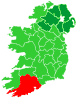

Are you planning on renting a car in Cork? We will compare the best car hire companies to get you the best price and overall deal. One way Car Rental is available. Rent a car at Cork Airport, and drop it off at Dublin Airport, Shannon Airport, Kerry Airport or Belfast, we will give you an all inclusive quote.
With free cancellation and no credit card fees you can book well in advance and lock the best price in.
 Best B&BS in Gougane Barra
 Best Hotels in Gougane Barra
 Gougane Barra Self Catering
 Cork Beaches
 Castles & Heritage
 Cork Golf Courses
 Cork Racecourse
 Cork Parks & Gardens
 Cork Pubs
 Cork Restaurants
 Cork Visitor Attractions
 Walking in Cork
 Car Hire
 Bus & Coach
 Cork Ferries
 Cork Airport
 Cork Taxi
 Trains